Design Trends 2026
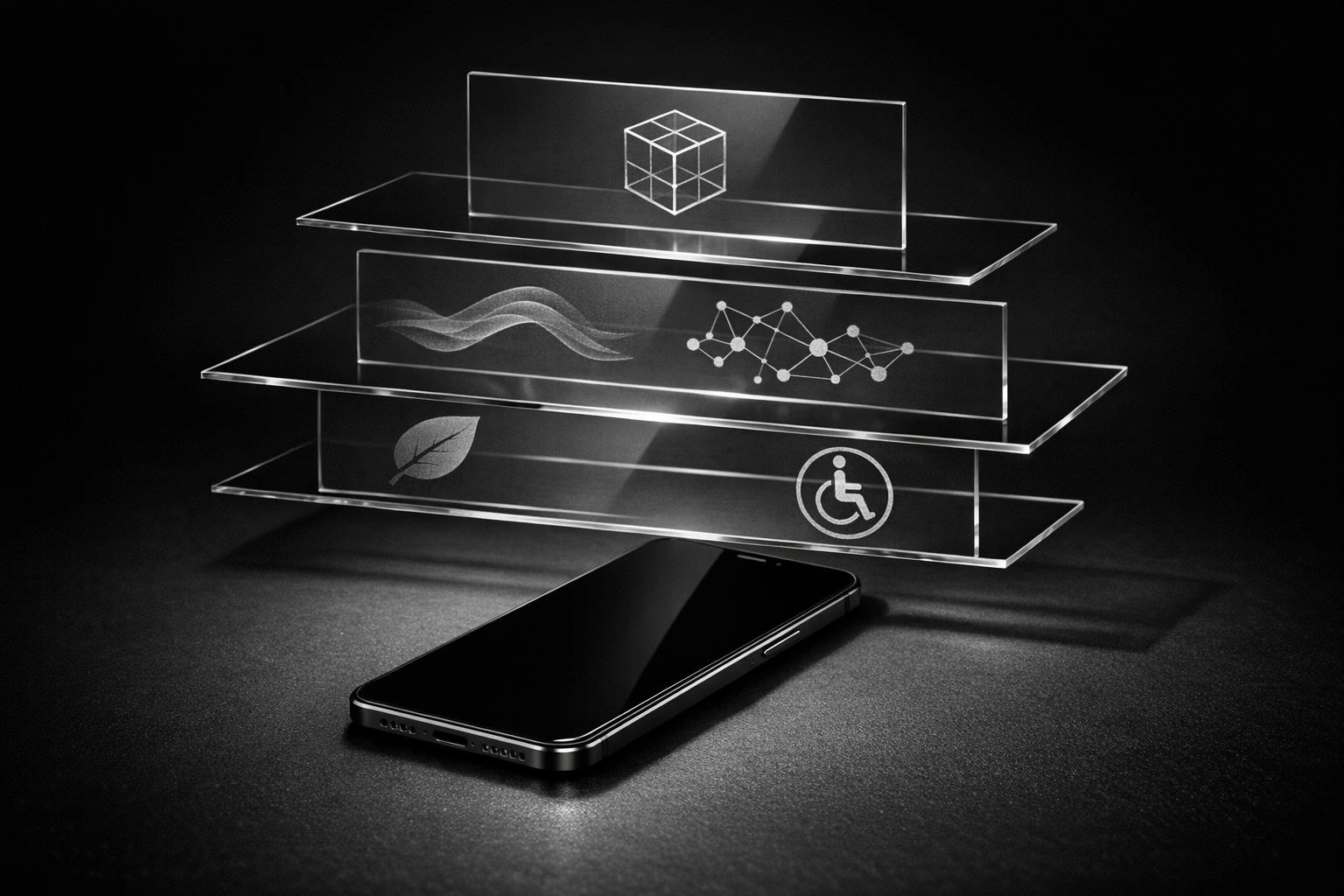
2026 brings exciting developments in design: 3D experiences, bold colours and AI-powered workflows take centre stage. At the same time, the desire for greater humanity and sustainability moves to the foreground. Companies must meet not only aesthetic but also legal requirements such as accessibility standards and ESG reporting obligations.
Key trends at a glance
- 3D design & AR/VR: Interactive brand stories and immersive experiences via WebGL, AR and VR.
- Colour & neo-minimalism: Vibrant palettes replace sterile designs, combined with clean layouts.
- Organic forms: Imperfect textures and natural elements create closeness and authenticity.
- AI in the design process: Automation for more efficient workflows, without losing the human touch.
- Sustainability & accessibility: Optimised websites for lower CO₂ output and legally compliant accessibility.
3D and spatial experiences in design
The design trends for 2026 show how 3D and spatial experiences are changing the way users interact with digital content: websites are evolving from simple, static layouts into dynamic platforms that tell interactive brand stories. Users can directly experience and explore products and brand worlds – a concept made possible by WebGL technology.
Given that 94% of a website’s first impression depends on visual design, this development is particularly relevant for sectors such as e-commerce and the automotive industry.
Bold colours and neo-minimalism
The design trend for 2026 is clear: minimalism is being reinterpreted. Instead of being perceived as cold and sterile, it gains energy through vibrant, saturated palettes. After years of muted neutrals dominating, we are now seeing the return of neon gradients, dopamine palettes and dual-tone combinations.
In 2026, brands are moving away from rigid colour palettes and instead embracing flexible colour themes that convey a mood or feeling. The use of dark mode as a background is particularly effective – saturated colours stand out more strongly against it.
Organic forms and imperfect textures
In 2026, designs increasingly rely on organic, human elements that give digital perfection a noticeably natural quality. This deliberate departure from flawless, AI-generated aesthetics manifests in flowing lines, asymmetric layouts and rough textures.
“In our increasingly loud and impersonal world, imperfect designs feel honest. That is exactly what makes them so powerful.”
AI-powered design workflows
AI-driven automation is increasingly shaping the world of modern design. In 2026, already 93% of web designers use AI tools to ease their daily workload. Such tools take over monotonous tasks like creating wireframes or generating placeholder text, leaving more room for strategic thinking and creative work.
Environmentally friendly and accessible design
Sustainability and inclusion are moving ever more firmly to the centre of attention. Since June 2025, the German Accessibility Strengthening Act (BFSG) has required many companies to implement accessibility features. Modern image formats such as WebP or AVIF can reduce file sizes by up to 90% compared to JPEGs.
Conclusion
The trends for 2026 go far beyond pure aesthetics. They shape how brands structurally interact with their audiences. Successful brands combine the efficiency of AI with creative individuality, invest in sustainable websites and favour organic designs over generic, perfect forms.